Society · 2026-08-20 · 12 MIN
Unanswered: Amelia Earhart's Last Morning
The disappearance is treated as one of the great mysteries, but the last few hours of it are written down, in pencil, on a US Coast Guard form that anyone can look at. What the logbook records is not a riddle. It is a radio conversation that only ever went one way, and a search that flew over the island everybody is still arguing about.
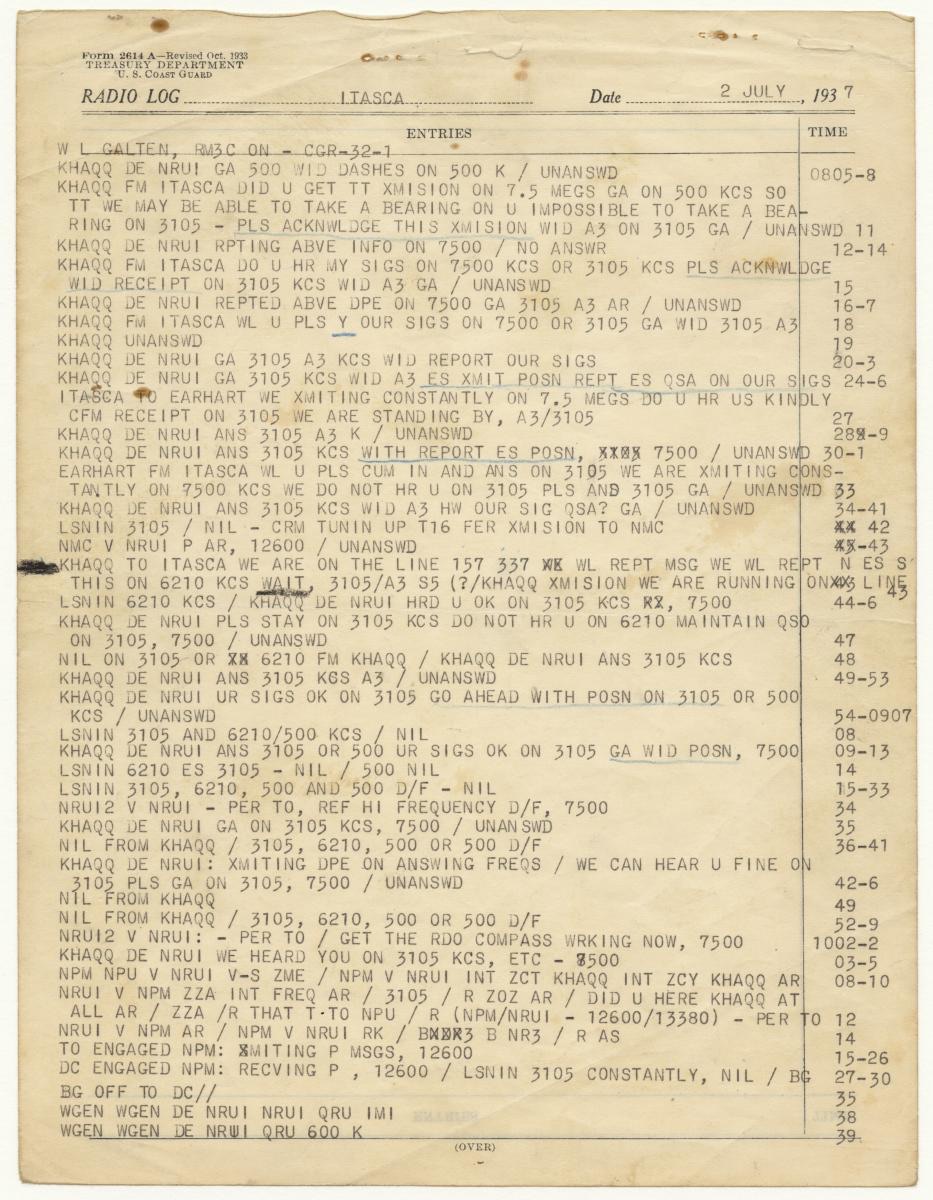
There is a sheet of paper in the National Archives at College Park, Maryland, headed Form 2614 A, revised October 1933, Treasury Department, United States Coast Guard. Somebody has written ITASCA in the blank marked for the ship, and 2 July, 1937 in the blank marked for the date. Underneath there are two columns. The wide one is for entries. The narrow one on the right is for the time.
The entries run down the page in capitals, in the clipped shorthand radio operators used. What they record is the Coast Guard cutter Itasca, anchored off Howland Island in the middle of the Pacific, trying over and over to talk to an aeroplane it could hear perfectly well and could not reach.
More than a dozen of those entries end with the same abbreviation. UNANSWD.
The disappearance of Amelia Earhart is filed under mystery, and there is a whole industry built on that filing. The last few hours are not mysterious at all. They are documented minute by minute on a government form, and what the form shows is a chain of ordinary, avoidable, thoroughly human failures, most of which were locked in before the aeroplane ever left the ground.
What the log says
The shorthand takes a minute to get used to. KHAQQ is the call sign of Earhart's aeroplane. NRUI is the Itasca. GA means go ahead, PLS is please, POSN is position, DE means "this is", and A3 is voice transmission as opposed to Morse.
At eight minutes past eight in the morning the Itasca sends dashes on 500 kilocycles and gets nothing back.
Three minutes later it sends this: "KHAQQ FM ITASCA DID U GET TT XMISION ON 7.5 MEGS GA ON 500 KCS SO TT WE MAY BE ABLE TO TAKE A BEARING ON U IMPOSSIBLE TO TAKE A BEARING ON 3105 PLS ACKNWLDGE THIS XMISION WID A3 ON 3105 GA." Then, in the same hand, UNANSWD.
The ship is telling her that it cannot take a bearing on the frequency she is using. It is asking her to move to one it can work with. And she does not hear the request.
Later on the page the Itasca sends: "XMITING DPE ON ANSWING FREQS / WE CAN HEAR U FINE ON 3105 PLS GA ON 3105, 7500." Unanswered again. They could hear her. She could not hear them. For the last hour of the flight the conversation was going in one direction only, and only one of the two parties knew it.
The last thing she sent is in there too, logged at 43 minutes past the hour: "KHAQQ TO ITASCA WE ARE ON THE LINE 157 337 WE WL REPT MSG WE WL REPT THIS ON 6210 KCS WAIT ... WE ARE RUNNING ON LINE."
157 and 337 are compass bearings, southeast and northwest. A line drawn through them is what a navigator gets from a sun sight. It does not tell you where you are. It tells you that you are somewhere along it. Fred Noonan had taken a sight on the rising sun and produced a line that should have passed through Howland. Running on the line means flying up and down it, hoping the island appears.
After that, the entries change. NIL FROM KHAQQ. Nothing from her at all.
And then, logged at two minutes past ten, long after the aeroplane had gone quiet and long after any of it could matter: "GET THE RDO COMPASS WRKING NOW."
The aeroplane, and who paid for it
The Electra was not really hers. In 1935 Purdue University hired Earhart, who was then about as famous as anyone in America, to spend a few weeks each semester living in the women's residence hall, advising the aeronautical engineering department and working as a counsellor on careers for women. By her own account she was the first woman in the country to hold that sort of post at a university.
In 1936 the Purdue Research Foundation put just over forty thousand dollars into a Lockheed Electra 10E for her, fitted out with new radio and navigation equipment and called the Flying Laboratory. The arrangement was that the aircraft would come back to Purdue when the flight was over, so the university could learn something from it.
Nobody at Purdue expected to be looking for it ninety years later.
What was already wrong at take-off
The Smithsonian's own account of the flight is unusually blunt for a museum. It lists the problems in order, and none of them is exotic.
The Electra's range was limited enough that Howland had to be used as a refuelling stop, and missing it meant disaster. Howland is a low coral island in open ocean more than 1,600 miles from Honolulu, with nothing else near it. The route took them over the Gilbert Islands, their best chance of fixing a position against known land, in the dark. Headwinds ate the fuel. Cloud interfered with the sun sights. The aircraft was poorly equipped for long range navigation and communication, and neither of them was well trained on the radio kit it did have.
Then there is the part that is hardest to read charitably. Neither Earhart nor Noonan could work Morse code, and Morse was how the direction finding system the Navy had laid on for them actually functioned. Voice was fine for chatting. Bearings needed code, or at minimum a frequency the marine direction finders could see, and 500 kilocycles was the only one of hers that qualified. She had dropped the trailing wire aerial that made 500 kilocycles usable. On Howland itself, the high frequency direction finder the Navy had put ashore was running down its battery.
There is a letter in the Smithsonian's collection from Commander P. V. H. Weems, the man who taught celestial navigation to a generation of record breakers, offering to train her. There is a second letter, from her husband and manager George Putnam, declining on her behalf. Noonan had been through the Weems course. After the flight the Baltimore Sun observed that he was the only one of Weems's students ever to have been lost at sea.
None of this makes her a fool. She was flying an aeroplane of 1937 across an ocean with instruments of 1937, and the safety margin on that leg was thin no matter who was aboard. It does mean that the loss was not the sea reaching up and taking her. It was a set of decisions, several of them made months earlier by people on the ground.
The largest search anyone had run
The Navy and the Coast Guard mounted what the National Archives calls the largest air and sea rescue search up to that time, and the official record of it is oddly moving because it is so procedural.
The battleship Colorado left Pearl Harbor with three Corsair floatplanes catapulted off her decks. From 7 July they searched at a thousand feet, in conditions the senior aviator reckoned good enough to spot a raft at five miles. By the time they stopped on 12 July, each aircraft had flown 21.2 hours and 1,908 miles, and the ship and her planes had covered 25,490 square miles of water.
The carrier Lexington then took over with sixty-three aircraft aboard, working the sea north and west of Howland. A newspaper headline on 15 July put the chances of finding them at one in a million. Three days after that it was called off. A sailor on the Colorado wrote that he did not think they would ever be found, because they had searched the most likely area.
On 9 July, in the middle of all this, Lieutenant John Lambrecht flew over an uninhabited coral atoll in the Phoenix group called Gardner Island. His report says that "signs of recent habitation were clearly visible but repeated circling and zooming failed to elicit any answering wave from possible inhabitants, and it was finally taken for granted that none were there." Asked later what he had meant by signs of habitation, he said markers of some kind. His own commanding officer's report said flatly that no dwellings and no other signs of habitation appeared on Gardner.
Two officers on the same ship, on the same day, describing the same island differently. That sentence of Lambrecht's has kept people busy for the better part of a century.
Declared dead by her own logbook
On 5 January 1939, eighteen months after she went missing, Judge Clarence Elliott Craig of the Los Angeles Superior Court declared Amelia Earhart legally dead, at Putnam's request. Doing it inside seven years was unusual and the judge said so.
To persuade him, Putnam brought a file of affidavits from the naval and Interior Department officers who had run the search. And he brought the Itasca's log. The Los Angeles Times account of the hearing records that the log was entered as evidence that the search had proved beyond a shadow of a doubt that she was dead. The judge fixed the date of death as 2 July 1937.
Her estate came to a little over ten thousand dollars.
The same sheet of paper that failed to reach her is the document that ended her, legally, in a courtroom in California.
What sails in October
Gardner Island is now called Nikumaroro and belongs to Kiribati. In 2020 somebody looking at satellite imagery of its lagoon noticed a shape that appears to have been sitting in the same place since 1938. It has been named the Taraia Object.
In July 2026 the cabinet of Kiribati approved an expedition to go and look at it. A team of sixteen is due to leave Tarawa by sea on 7 October and sail roughly 830 nautical miles to the island, where they will spend several days trying to establish whether that shape is the remains of a Lockheed Electra 10E.
The expedition is run by the Archaeological Legacy Institute, with Richard Pettigrew leading it. The money and the institutional weight come from the Purdue Research Foundation. The same body that bought the aeroplane in 1936, on the understanding that it would be given back afterwards, is paying to go and collect it.
Two cautions. Nikumaroro has been argued for since the late 1980s, principally by a group that has run repeated expeditions there and found nothing conclusive, and the argument rests heavily on that one line in Lambrecht's report which his own captain contradicted. And a shape in a lagoon is a shape in a lagoon until somebody puts their hands on it. Kiribati approving the trip does not make the object an aeroplane.
But it is a testable claim with a date attached to it, which puts it several rungs above most of what gets said about Earhart.
The logbook will not change either way. It will stay in College Park, a Coast Guard form filled in by a man who could hear a woman's voice from the middle of the Pacific perfectly clearly, and who wrote UNANSWD after every single thing he said back to her.
Sources
- National Archives, "Radio Log of the Last Communications of Amelia Earhart" (the log pages themselves, National Archives Identifier 6210268; L. G. Bellarts on post from 7 p.m. on 1 July; the KHAQQ call sign; the 0843 final message; the 1 June 1937 departure from Miami; and the description of the largest air and sea search up to that time). All quoted log entries are read directly from the scan of the 2 July 1937 page reproduced there.
- Smithsonian Institution, "Navigation Gone Wrong: Amelia Earhart" (the Electra's limited range forcing the use of Howland; the Gilberts overflown in darkness; headwinds and cloud; neither pilot nor navigator knowing Morse; the aircraft being poorly outfitted for navigation and long range communication; the Weems letter and Putnam's refusal on her behalf; and the Baltimore Sun line about Noonan).
- Naval History and Heritage Command, "Naval Aviation and the Search for Amelia Earhart" (Howland lying over 1,600 miles from Honolulu; Colorado and her three Corsair floatplanes; searching from 1,000 feet with a raft visible at five miles; 21.2 hours and 1,908 miles per aircraft; 25,490 square miles covered; Lexington taking over on 12 July with sixty-three aircraft; the one in a million headline of 15 July; the suspension on 18 July; and the Colorado sailor's remark).
- TIGHAR, "Gardner Overflight" (the 9 July 1937 flight over Gardner Island, Lambrecht's report of signs of recent habitation, his later gloss that he meant markers of some kind, and Captain Friedell's contradicting report. TIGHAR has argued the Nikumaroro case since the 1980s and is not a disinterested party, which is why its own documents are cited here rather than its conclusions).
- Purdue University, "Amelia Earhart: Aviator. Legend. Boilermaker." (her appointment from 1935 as counsellor on careers for women and adviser to the aeronautical engineering department, her claim to have been the first woman in the country in such a post, and the Purdue Research Foundation putting just over 40,000 dollars into the Electra in 1936).
- Purdue University, "ALI, Purdue expedition to search for Amelia Earhart's plane will depart in October" (the Kiribati cabinet approval, the sixteen person crew leaving Tarawa by sea on 7 October 2026, the 830 nautical miles to Nikumaroro, Richard Pettigrew leading for the Archaeological Legacy Institute, and the Taraia Object first appearing in satellite imagery in 2020 and apparently unmoved since 1938).
- Purdue Research Foundation, "Purdue Research Foundation and Archaeological Legacy Institute to embark on expedition to identify Amelia Earhart's missing plane" (the foundation having financed the flying laboratory Electra, and Earhart's intention to return the aircraft to Purdue after the flight).
- This Day in Aviation, "5 January 1939" (Judge Clarence Elliott Craig declaring her dead in absentia at Putnam's request, the judge calling the procedure extraordinary, the Itasca log being entered in evidence, 2 July 1937 fixed as the date of death, and the estate of a little over 10,000 dollars, reproducing the Los Angeles Times report of the hearing).