Politics · 2026-08-21 · 10 MIN
Universal, With Conditions
Every country has a date on which it says it introduced universal suffrage, and almost every one of those dates is doing quiet work for a set of exclusions that came with it. The word arrives first and the thing it describes arrives decades later, if it arrives at all.
There is a photograph taken in the town square at Appenzell, in the north east of Switzerland, on 24 April 1966. It shows several thousand people packed in shoulder to shoulder under bare trees, with a café sign visible over their heads, and a forest of arms in the air. This is the Landsgemeinde, an open air assembly where citizens vote on cantonal business by raising a hand and someone at the front estimates which side has more.
Every arm in the photograph belongs to a man. There are women in it, standing at the edges, watching.
Swiss men voted to let Swiss women into federal elections on 7 February 1971, which is late enough to be a well known embarrassment. What is less well known is what happened afterwards in Appenzell Innerrhoden, where the men of the canton went on refusing to admit women to their own assembly, turning it down again in the spring of 1990. A hundred signatures were collected and the matter went to the Federal Supreme Court in Lausanne. On 27 November 1990 the court held, unanimously, that a canton could not do this, because the constitution had guaranteed equality between the sexes since 1981.
Women first raised their hands in that square on 28 April 1991.
This is not really a story about Switzerland. Almost every country has a date on which it says it introduced universal suffrage, and almost every one of those dates is doing quiet work for a list of people it left out.
What the word actually covered
The clearest way to see this is to read one of the statutes rather than a summary of it.
The electoral law for the Reichstag of the North German Confederation, dated 31 May 1869, is short and readable and was, for its time, genuinely radical. Any North German man of twenty five or over could vote where he lived. The vote was cast in person, on a secret ballot, put into a box unsigned. In an era when Britain still ran a property qualification and the ballot was not yet secret there, this was a wide franchise.
It was also, in the same document, closed to a number of people. Anyone under legal guardianship. Anyone in bankruptcy proceedings. Anyone receiving poor relief. Anyone who had lost their civil rights through a criminal conviction. And every woman, and every man under twenty five, which between them accounted for well over half the population.
The archive that publishes the law notes, dryly, that this arrangement was "described in shorthand as 'universal'."
France had done the same thing twenty one years earlier. The provisional government of 1848 declared that all French men could vote from the age of twenty one and called the result universal suffrage, a phrase it kept using while excluding every woman in the country. French women were not admitted until 1944.
The pattern holds nearly everywhere. The word arrives, the thing does not, and the gap between them is filled with qualifications that sound technical and are not: a property line, an age, a literacy test, a residence rule, a category of person deemed not to be managing their own affairs.
Who was handing it over, and what they got
There is a comfortable version of this history in which the franchise widens because people argued well and the argument was won. Some of it did happen that way. A good deal of it did not.
The German law above was brought in under Otto von Bismarck, who was not an enthusiast for popular government, and it sat on top of a constitution that kept real power with the Bundesrat and with the King of Prussia. You could have the widest franchise in Europe and vote in a chamber that could not bring down a government.
What is interesting is what the electorate then did with it.
Turnout in the Reichstag elections was about 61 per cent in 1874. By 1887 it was almost 78 per cent. The Catholic Centre Party built a substantial bloc of deputies out of constituencies nobody had planned for. And the Social Democrats, who took roughly 350,000 votes in 1874, took 1,400,000 in February 1890, close to a fifth of the popular vote and more than any other party in the country.
Whatever the calculation had been when the franchise was drawn up, that was not it. The franchise a conservative chancellor introduced put the Social Democrats at the top of the poll in February 1890, the same year he left office.
The biggest single act of enfranchisement
Almost everywhere the franchise arrived in instalments, each one argued over for a generation. India did it in one movement, and did it at a scale that still has no real parallel.
The constitution that came into force in January 1950 gave the vote to every adult, at a point when the country had just come through partition, had almost no electoral machinery, and had a population of whom the large majority could not read. Sukumar Sen, an Indian Civil Service officer and a mathematician, was made Chief Election Commissioner in March 1950 and given the job of building an electorate from nothing.
The numbers are worth setting out because they are not really believable. Around 173 million voters. More than seventy per cent of them unable to read. About 224,000 polling booths, roughly one for every thousand voters. Some 620 million ballot papers printed. Around 21 million steel ballot boxes, manufactured by Godrej. Some 16,500 clerks hired on contract simply to write the electoral rolls, and about a million officials to run the poll, which ran from October 1951 into the following year.
The literacy problem produced the solution everyone now takes for granted. Since most voters could not read a candidate's name, each candidate was given a picture: a lamp, a hut, a pair of bullocks, a hammer and sickle. Every candidate got a separate ballot box marked with their symbol, and you put your paper in the box with the right picture on it.
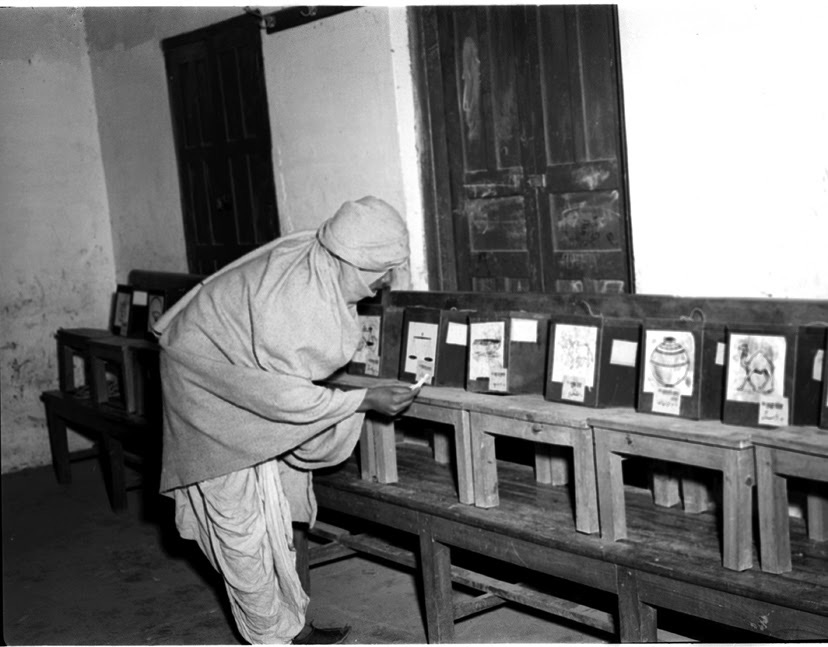
Nearly 80 million women went onto the rolls. About 2.8 million did not, because when the enumerators came round they gave their identity as somebody's wife or somebody's mother rather than their own name, and Sen took the view that a roll built on that could not be relied on and struck them off.
Given, and then taken back
The other thing the standard timeline hides is that the franchise runs backwards as well as forwards.
The Fifteenth Amendment to the United States constitution was ratified in 1870 and says the right to vote shall not be denied on account of race, colour, or previous condition of servitude. In 1896 Louisiana had 130,344 Black voters on its rolls.
In 1898 the state wrote a new constitution with a poll tax, a literacy requirement and a grandfather clause that in practice exempted only white registrants. By 1904 there were 1,342 Black voters on the Louisiana rolls. By 1940 there were 897.
When the courts struck down the grandfather clause, the 1921 convention replaced it with an understanding clause: a prospective voter could be asked to give a reasonable interpretation of any section of the state constitution, and the registrar decided whether the interpretation was reasonable. Mississippi ran a version of the same thing, adding a good moral character requirement in 1960, forbidding anyone to help a citizen with the form, and forbidding registrars to explain why they had rejected one.
None of that mentions race. All of it was written to be applied by hand.
By 1964, 6.7 per cent of eligible Black adults in Mississippi were registered. In Sunflower County there were 13,000 eligible Black voters and fewer than 200 on the roll. In Leflore County, 250 out of a Black population of about 30,000.
Then the Voting Rights Act passed in 1965, with federal examiners and a requirement that certain states clear changes to their election rules in advance. By 1967 Black registration in Mississippi was 59.8 per cent. Ninety five years after the constitutional amendment that supposedly settled it.
Back to the square
On 28 April 1991 about four thousand people gathered at Appenzell for the Landsgemeinde, and roughly a third of them were women, standing in the ring for the first time rather than at the edge of it, entitled to raise a hand and have it counted.
One woman spoke.
A room full of people who have spent their whole lives being told the decision is not theirs does not start talking on the first afternoon. The right on paper and the use of it are separated by a period nobody puts in the timeline.
Most of the men in that 1966 photograph were still alive in 1991. They had voted three times to keep the square as it was. Then a court in Lausanne told them they could not, and the following spring they came back and stood next to their wives and their daughters and put their hands up about the cantonal budget.
Sources
- German History in Documents and Images, "Electoral Law for the Reichstag of the North German Confederation (May 31, 1869)" (the text of the law itself: the vote for men of twenty five and over, the secret unsigned ballot, and the exclusion of wards, bankrupts, recipients of poor relief and the criminally convicted, together with the archive's own note that the arrangement was described in shorthand as universal).
- German History in Documents and Images, "Forging an Empire: Bismarckian Germany, Introduction" (Bismarck leaving office in 1890; universal manhood suffrage after 1867 expanding the political nation; turnout rising from about 61 per cent in 1874 to almost 78 per cent in 1887; the Centre Party's Reichstag bloc; and the Social Democrats going from roughly 350,000 votes in 1874 to 1,400,000 in February 1890, almost 20 per cent and more than any other party).
- SWI swissinfo.ch, "A visit to Appenzell Inner Rhodes, the last canton to grant women the right to vote in Switzerland" (the federal vote of 7 February 1971; the Landsgemeinde rejecting women's suffrage for the third time in spring 1990; the hundred signatures and the action before the Federal Court; women taking part on 28 April 1991; about four thousand present with roughly a third of them women; and only one woman speaking).
- The Anthology of Swiss Legal Culture, "The Protection of Political Rights for Women in the Swiss Cantons by the Supreme Federal Court, BGE 116 Ia 359" (the judgment of 27 November 1990 in Theresa Rohner and others against Appenzell Innerrhoden, and the reasoning that the cantonal reservation could no longer stand against the equality clause introduced into the federal constitution in 1981).
- Swiss Federal Supreme Court, "BGE 116 Ia 359" (the decision itself, in the court's own reporter).
- Observer Research Foundation, "The first CEC who shaped India's elections" (Sukumar Sen's appointment in March 1950; roughly 173 million voters with over seventy per cent unable to read; 224,000 polling booths; 620 million ballot papers; 21 million steel ballot boxes made by Godrej; 16,500 contract clerks for the rolls; about a million officials; nearly 80 million women enrolled; and 2.8 million women struck off for not giving their own names).
- 64 Parishes, Louisiana Endowment for the Humanities, "Louisiana v. the Franchise" (130,344 Black voters in 1896, 1,342 by 1904 and 897 by 1940; the 1898 constitution's poll tax, literacy requirement and grandfather clause; and the 1921 understanding clause leaving final authority with the registrar).
- United States Commission on Civil Rights, "The Mississippi Delta Report, Chapter 3" (6.7 per cent of eligible Black adults registered in Mississippi in 1964; fewer than 200 of 13,000 in Sunflower County and 250 of about 30,000 in Leflore County; the 1960 good moral character requirement and the bans on assistance and on explaining rejections; and registration reaching 59.8 per cent by 1967).
- National Archives, "15th Amendment to the U.S. Constitution: Voting Rights (1870)" (the text and ratification date of the amendment).