Infrastructure · 2026-08-18 · 12 MIN
Four Feet Eight and a Half: The Cart Track the World Still Runs On
The railway is about a century older than the locomotive. What got invented in the coalfields was the road, not the engine, and the width of that road was settled by colliery wagons in Northumberland. Britain made it law on 18 August 1846, having first been told in writing that the rival gauge was better. India spent thirty-three years and most of a network undoing the same kind of decision.
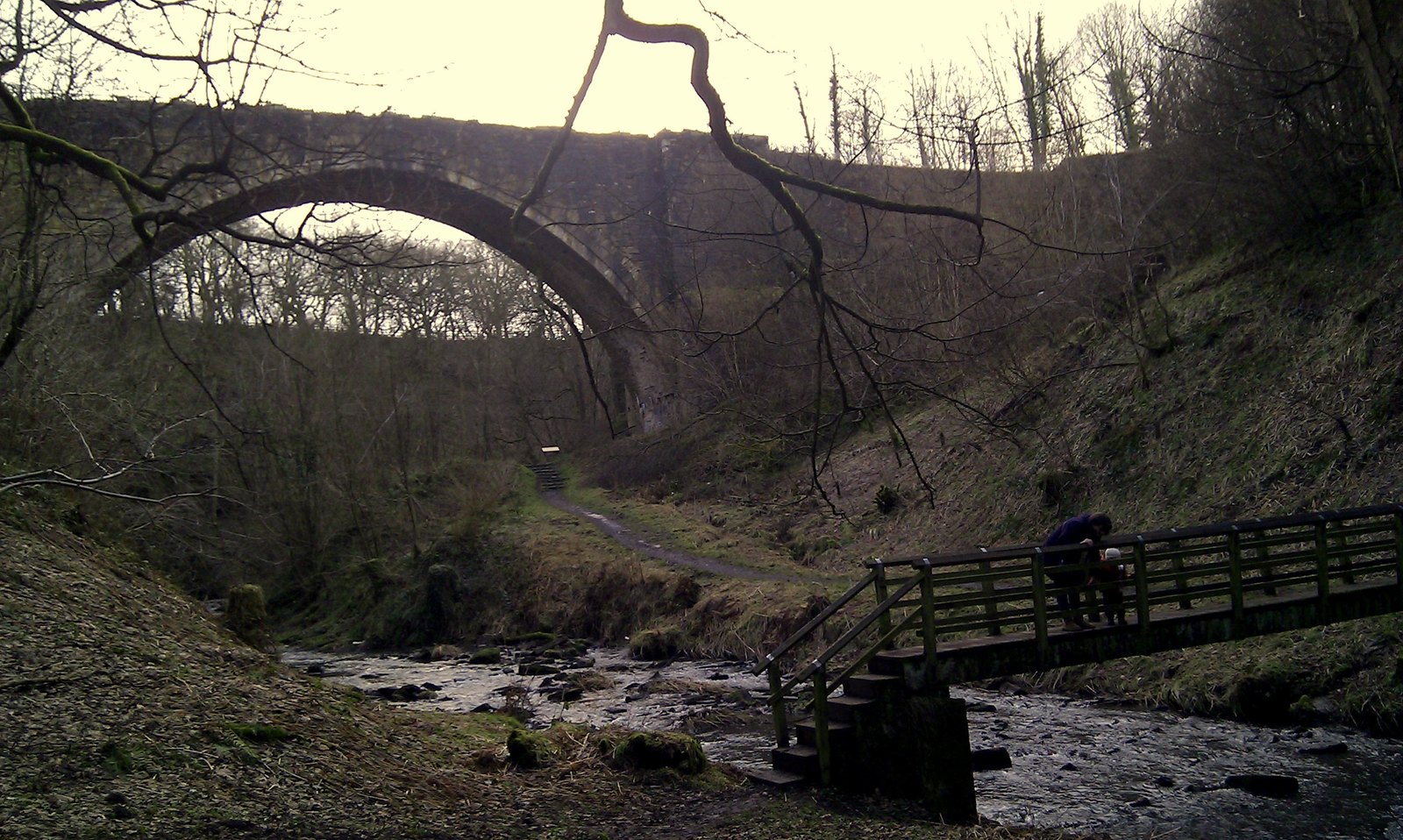
There is a stone bridge in County Durham standing eighty feet above a wooded burn, on a single arch spanning a hundred and two feet. When it was finished in 1726 it was the longest span in Britain, and it held that record for thirty years. It cost twelve thousand pounds, an enormous sum, paid for by a syndicate of coal owners called the Grand Allies.
No train has ever crossed it.
The Causey Arch was built to carry a wagonway: two tracks of wooden rails, one for loaded coal wagons going down to the Tyne and one for the empties coming back, with horses doing the pulling and gravity helping on the descent. At its peak more than nine hundred wagons a day went over it. The mason was a man called Ralph Wood, and the story attached to him, which the record repeats without properly supporting, is that he was so convinced the arch would fall that he killed himself the year after it opened.
The first locomotive would not run anywhere for another seventy-eight years.
The engine came late. What was invented in the coalfields, and invented slowly over about two centuries, was the road, and every advance after that was an upgrade to a road that already existed. Which is why a very large part of the world now runs on a width that was settled by coal wagons in Northumberland, and why the countries that chose differently have spent enormous sums going back and changing their minds.
What the rails were actually for
A horse pulling a loaded wagon along an ordinary road in the eighteenth century managed something in the region of two or three tons, and less than that if the road was wet, which in England it usually was. Put the same horse on rails and the figure went to somewhere between ten and thirteen tons.
Nothing about the horse had changed. What changed was the surface. A wheel on a smooth hard rail loses very little energy to the ground compared with one sinking into mud, and a guided wheel does not need steering, so the whole load goes into pulling. That is the entire idea, and it is worth about a fourfold increase in what one animal can move.
The earliest wagonway in Britain that is properly documented was built in 1604 by Huntingdon Beaumont, who ran a wagonway about three kilometres from the pits at Strelley to a distribution point at Wollaton. It was made of wood throughout, rails and sleepers and the pins holding them together. Beaumont went bankrupt, which happened to a great many people who were early to it.
Wood works and wood wears out, so the next two centuries were spent replacing the running surface with something harder. Coalbrookdale began casting iron rails in 1767. In the 1790s Benjamin Outram was laying L-shaped iron plates with the guiding flange on the track itself, so that ordinary flat-wheeled carts could use it. William Jessop had already gone the other way in 1789, laying smooth edge rails and putting the flange on the wheel, which is the arrangement the entire world uses now. Plate rails filled with mud and stones and bound the wheels. Edge rails did not. By 1820 John Birkinshaw had a rolling process for long wrought iron rails, which meant fewer joints, which meant a surface that could take more weight at more speed.
Every one of those is a change to the road.
The first locomotive-hauled journey anywhere in the world ran on 21 February 1804, when Richard Trevithick took an unnamed engine along the tramroad at Penydarren in south Wales with ten tons of iron, five wagons and seventy men behind it, averaging something under three miles an hour. The tramroad was already there, laid to be worked by horses.
When George Stephenson ran the locomotive Blücher at Killingworth in 1814, the same was true. He was not building a railway. The railway was there, and coal had been moving along it behind horses for years, and what he did was replace the horse. That distinction gets lost because the engine is the exciting part, but it matters, because it explains what happened to the measurement.
Where the number came from
You have probably met the story. Standard gauge is four feet eight and a half inches because that was the width of a Roman chariot, which was the width of two horses, and so on down a chain that ends with a rocket booster in Utah being sized by the backside of a Roman horse. It is a good story and it is repeated in a great many places.
The real answer is duller and closer to hand. Stephenson worked at Killingworth colliery, north of Newcastle, and the wagons there ran on a gauge of four feet eight inches. He built his engines to fit the track he had. When he went on to build lines elsewhere he took the number with him, and for the Liverpool and Manchester Railway in 1830 he added half an inch of slack to stop the wheels binding on curves.
There was no standard before that. The wagonways of Britain ran on all sorts of widths, four feet and four feet four and four feet seven and a half and five feet among them, which is exactly what you would expect from hundreds of separate collieries each solving their own problem, and which kills the Roman version outright. If everyone had inherited one ancient measurement, the coalfields would not have been full of different ones.
What Stephenson had was not the best gauge. It was the gauge in front of him, and he was the man building most of the early lines.
The better gauge lost
Isambard Kingdom Brunel looked at four feet eight and a half and concluded, correctly, that it was too narrow. The Great Western Railway opened in 1838 on a gauge of seven feet and a quarter inch. The extra width let him put the carriage body between the wheels rather than above them, which lowered the centre of gravity, which meant a train that was steadier and faster and considerably more comfortable. On the engineering, Brunel was right.
He was also surrounded. By the 1840s most of the rest of Britain had been built by Stephenson or by men who had worked for him, all of it on the narrow gauge, and the two systems were expanding towards each other.
They met at Gloucester in 1844, where the broad gauge line up from Bristol ran into the narrow gauge line down from Birmingham. Nothing could run through. Every passenger continuing a journey got out of one train and into another, and every crate, sack, barrel and animal had to be lifted across by hand. The Illustrated London News sent an artist, and the engraving at the top of this article is what he came back with: porters hurling luggage, a hamper marked G.W.R., a crate marked GLASS going over sideways, a woman with two children pressed against the wall of it, and a sign pointing to the Birmingham train.
Parliament appointed a Royal Commission on Railway Gauges in 1845. It examined both systems and reached two conclusions that sit oddly together. The broad gauge was the better piece of engineering. The broad gauge had to go.
The reasoning was arithmetic. There were already far more miles of narrow gauge in the ground, and converting them would cost more than converting the smaller broad gauge network, so the cheaper answer was to kill the better system. On 18 August 1846, a hundred and eighty years ago today, the Gauge Act received royal assent and fixed four feet eight and a half inches as the standard for Great Britain, and five feet three for Ireland. Brunel's seven feet was permitted to continue where it already ran, in the south west and in Wales, and nowhere else. A standard with a boundary drawn around it is a standard with an expiry date.
It took until 1892 to finish. Conversion had been going on line by line since the 1860s, and what was left by then was the last unmixed stretch in the far west. Over the weekend of 21 and 22 May 1892, somewhere near four thousand seven hundred platelayers and gangers moved a hundred and seventy-seven miles of track between Exeter and Truro, including the branches, from seven feet to four feet eight and a half. They slept in goods sheds and waiting rooms and tents. They were fed on an oatmeal drink and no alcohol was allowed anywhere near the job. The Sunday night mail from Paddington ran through to Penzance on the new gauge, on time.
Forty-six years, to correct a decision that the state had been told in writing was the wrong one on the day it made it.
Somewhere between fifty-five and sixty percent of the world's railway track is now four feet eight and a half inches apart, depending on whose count you take. Not because anyone measured and chose it. Because Stephenson had it, Stephenson built most of the first lines, and after that the cost of being different rose every year that somebody laid more of it.
What it cost India to change its mind
The same argument ran in India, in slow motion, and the bill arrived in the twentieth century.
Lord Dalhousie was Governor-General when the first line opened, and he did not want the British standard. He argued for something wider on the grounds that the country was vast and the traffic would be heavy, and after some negotiation with the East India Company the figure settled at five feet six inches. That is wider than standard gauge and wider than almost anything else in regular use anywhere, and as a decision it has aged extremely well.
Then in 1870 Lord Mayo introduced a second gauge. The reasoning was cost. Broad gauge was expensive to build, much of the country was not going to generate heavy traffic for decades, and a metre gauge line could open up Rajputana or the Punjab for a fraction of the money. Judged as a way of getting track into places that had none, it worked.
Judged as a network, it did not, because the two gauges do not touch. A wagon of grain on metre gauge cannot roll onto broad gauge. It has to be emptied and refilled, which is the Gloucester problem with a subcontinent attached to it, repeated at every junction between the two systems for over a century.
At independence in 1947 the network was split almost down the middle: 25,170 km of broad gauge, 24,153 km of metre gauge, and another 5,225 km of assorted narrow gauges. Forty-four percent of the railways of a newly independent country could not exchange a wagon with the other forty-six percent.
Project Unigauge started on 1 April 1992, with the aim of converting the lot. It has been running ever since, line by line, each one closed while the work is done. By March 2025 broad gauge accounted for 67,372 km and just over ninety-seven percent of the network. Metre gauge was down to 894 km and the narrow gauges to 1,173 km.
Thirty-three years of continuous work, and it is not finished, to undo a decision taken in 1870 because the cheaper option was cheaper.
What is left
Standard gauge is not a standard in the sense of something anybody selected. It is the width of a colliery wagon in Northumberland, preserved by the fact that Stephenson got there first and that every mile of track laid afterwards made the alternative more expensive to switch to. Brunel's was better. Brunel's went in 1892, over a weekend, by four thousand seven hundred men on oatmeal.
The Causey Arch is still there, carrying nothing. It is a footbridge now, and people walk over it on their way round the woods without much reason to think about what it was for. It was built to hold nine hundred coal wagons a day at a time when the fastest thing on it was a horse, by men who had no idea they were laying out the dimensions of the next three hundred years, and who would have been baffled to learn that the part of their work which survived was not the stone.
Sources
- Wikipedia, "Causey Arch" (the 1725 to 1726 build, Ralph Wood, the Grand Allies, the 102 foot span and 80 foot height, the £12,000 cost, the two tracks for loaded and empty wagons, and more than 900 wagons a day).
- Wikipedia, "Wagonway" (a horse moving 10 to 13 long tons on rails against roughly a quarter of that on roads, the Coalbrookdale cast iron rails of 1767, Outram's plate rails, Jessop's edge rails of 1789, and Birkinshaw's wrought iron rolling process of 1820).
- Wikipedia, "Richard Trevithick" (the first locomotive-hauled railway journey on 21 February 1804 along the Penydarren tramroad, carrying ten tons of iron, five wagons and seventy men).
- Wikipedia, "Wollaton Wagonway" (Huntingdon Beaumont's line of 1604 from Strelley to Wollaton, about three kilometres, built entirely of wood).
- Wikipedia, "Diolkos" (the paved trackway across the Isthmus of Corinth from around 600 BC, with cut grooves guiding wheeled platforms).
- Wikipedia, "Standard-gauge railway" (Stephenson favouring four feet eight inches across the Northumberland and Durham wagonways and using it at Killingworth, the half inch added for the Liverpool and Manchester Railway to reduce binding on curves, the varied gauges in use beforehand, and the share of the world's lines now on standard gauge).
- Wikipedia, "Railway Regulation (Gauge) Act 1846" (royal assent on 18 August 1846, four feet eight and a half inches for Great Britain and five feet three for Ireland, and the geographically limited permission for Brunel's seven foot gauge).
- Wikipedia, "Royal Commission on Railway Gauges" (the 1845 commission accepting that the broad gauge was technically superior and recommending its abolition anyway, on the grounds that converting the far larger narrow gauge network would cost too much).
- Wikipedia, "Birmingham and Gloucester Railway" (the 1844 meeting of the broad gauge line from Bristol and the narrow gauge line from Birmingham at Gloucester, and the transfer of passengers and goods it forced).
- Broad Gauge Society, "The GWR broad gauge conversion of May 1892" (the last broad gauge trains on 20 May, the conversion over the weekend of 21 and 22 May by around 4,700 platelayers and gangers, the 177 miles between Exeter and Truro including branches, the oatmeal drink and the ban on alcohol).
- Wikipedia, "Broad-gauge railway" (Brunel's seven feet and a quarter inch, the 1838 Great Western Railway, and conversion running from the 1860s to the final weekend in 1892).
- Wikipedia, "Project Unigauge" (the launch on 1 April 1992, the 1947 split of 25,170 km broad gauge against 24,153 km metre gauge and 5,225 km narrow, and the March 2025 position of 67,372 km and 97.02 percent broad gauge, 894 km metre gauge and 1,173 km narrow).
- Live History India, "Indian Railways: Battle of the Gauges" (Dalhousie arguing against the British standard and settling on five feet six inches, and Lord Mayo introducing metre gauge in 1870 on grounds of economy for lightly trafficked regions).