Infrastructure · 2026-08-19 · 12 MIN
Fifty-Eight Boxes Out of Newark
The shipping container was not invented in 1956, and the famous story of how a truck driver dreamed it up on a New Jersey pier is almost certainly something he made up in old age. What actually happened was slower, duller and far more consequential, and it went through a war and a committee before it reached anyone's shop.
The story goes that in 1937 a young trucker from North Carolina named Malcom McLean drove a load of cotton bales to a pier in New Jersey and then sat there for most of the day. He could not leave until his trailer was empty, and emptying it meant dockers carrying the bales aboard by hand, one bale at a time, with other trucks queued up behind him waiting their turn. Watching this, he is supposed to have thought that it would be far quicker to lift the entire trailer onto the ship and be done with it.
That is the founding story of modern trade. McLean told it himself. It turns up in almost every account of where the shipping container came from.
Marc Levinson, who wrote the standard history of the thing, does not believe a word of it. "McLean started to tell it when he was quite advanced in age, and there's no evidence that it's true," he has said. There is also the problem of the arithmetic. McLean did not actually put a box on a ship until the mid 1950s, so to believe the story you have to accept that a restless and impatient businessman had the commercial insight of the century and then did nothing about it for nearly twenty years.
Containers were not his invention either. Railway companies and shipping lines on both sides of the Atlantic had been trying versions of them for about fifty years before he arrived, and had generally decided they did not pay.
What McLean actually did was slower and much duller than the legend, which is presumably why he preferred the legend. In Levinson's words, "He took an idea that was hundreds of years old, was almost universally judged to be uneconomic, and made it so that it can be generally applied."
What it used to cost to load a ship
A cargo ship before the box was a different kind of object altogether.
Freight went aboard as break-bulk, which is a polite way of saying loose. Sacks, barrels, crates, bales, drums, car parts, tinned food, all of it different shapes and weights, all of it stacked into a hold by gangs of men with hooks and slings and a great deal of shouting. Everything had to be fitted around everything else so the load did not shift at sea. Every item was handled individually going in and individually coming out.
Ships spent longer tied up than they spent moving. That was the accepted state of affairs. A vessel might sit at a berth for a week while its cargo was picked apart and reassembled, and while it sat there it earned nothing, and the pilferage was constant, because a case of whisky in an open hold is a case of whisky within reach of forty people.
McLean's people costed it. Loading a ton of general cargo onto an ordinary ship in 1956 came to 5.83 dollars. Loading a ton into a container and craning the container aboard came to less than sixteen cents.
That is a ratio of about thirty-six to one. Nobody in the industry seriously disputed the figure. What took another fifteen years was agreeing on whose box everyone would use.
Fifty-eight boxes
McLean bought a Second World War oil tanker, had a steel deck built over the top of it, and renamed it the Ideal X. On 26 April 1956 it left Port Newark for Houston with fifty-eight containers, thirty-five feet long each, sitting on that deck, along with fifteen thousand tons of petroleum in the tanks below. It arrived five days later and lorries took the boxes away to factories and warehouses.
Loading it took under eight hours.
The following year Sea-Land put the Gateway City into service, the first ship built to carry containers and nothing else. McLean had come out of trucking, not shipping, and he never really stopped thinking like a haulier. His view was that he was not in the business of running ships. He was in the business of moving other people's goods from where they were made to where they were wanted, and the ship was one leg of that, no more important than the lorry or the rail wagon.
The Ideal X itself carried boxes for eight years and was then broken up for scrap.
Why the box nearly did not work
It very nearly stalled at that point, for a reason that has nothing to do with ships.
A container is only useful if it fits things that other people own. It has to fit the crane at the far end, the chassis of a lorry in a country you have never visited, the rail wagon it will sit on for the last two hundred miles, and the cell guides of a ship belonging to a rival company. If your box is thirty-five feet and everyone else's is twenty-four or twenty-seven or thirty, all you have built is an expensive private system that stops at your own quay.
By the early 1960s that is exactly what existed. Competing firms with competing boxes, none of them interchangeable, each one a small walled garden.
The fix came from a committee. The International Organization for Standardization set up Technical Committee 104 on freight containers, with the secretariat held by the American standards body, and it began work in 1961. A draft was adopted in 1964. In May 1965 that draft went out to every ISO member country for comment. It came back approved by twenty of them, including Britain, the United States, Germany, Italy, the Netherlands and Sweden.
Five voted against: Australia, France, Ireland, Poland and the Soviet Union.
The ISO Council accepted it anyway, in February 1968, as Recommendation R 668, Dimensions and Ratings of Freight Containers. It opens by defining what a freight container actually is, and the definition does a great deal of work in very flat language. A freight container is equipment "of a permanent character and accordingly strong enough to be suitable for repeated use", "specially designed to facilitate the carriage of goods, by one or more modes of transport, without intermediate reloading", "fitted with devices permitting its ready handling, particularly its transfer from one mode of transport to another".
Without intermediate reloading. That is the sentence that emptied the docks.
McLean also gave up his patent rights, so that anyone could build to the standard without paying him for the privilege. That is the part of his record which deserves the credit the cotton bale story keeps getting.
The war that settled it
The container's commercial argument was won in Vietnam.
In 1967 Sea-Land contracted to run a full container service into the enormous American supply base at Cam Ranh Bay, with a smaller operation at Da Nang. The company paid for the lot itself: reinforcing the pier, floating cranes and vehicles across from the Philippines, assembling the gantries on site, building the truck terminals. Between 1967 and 1973 its defence revenues came to 450 million dollars. In the peak year, 1971, military work was 30 per cent of the company's sales. In 1968 its ships on that run were sailing at 99 per cent of capacity.
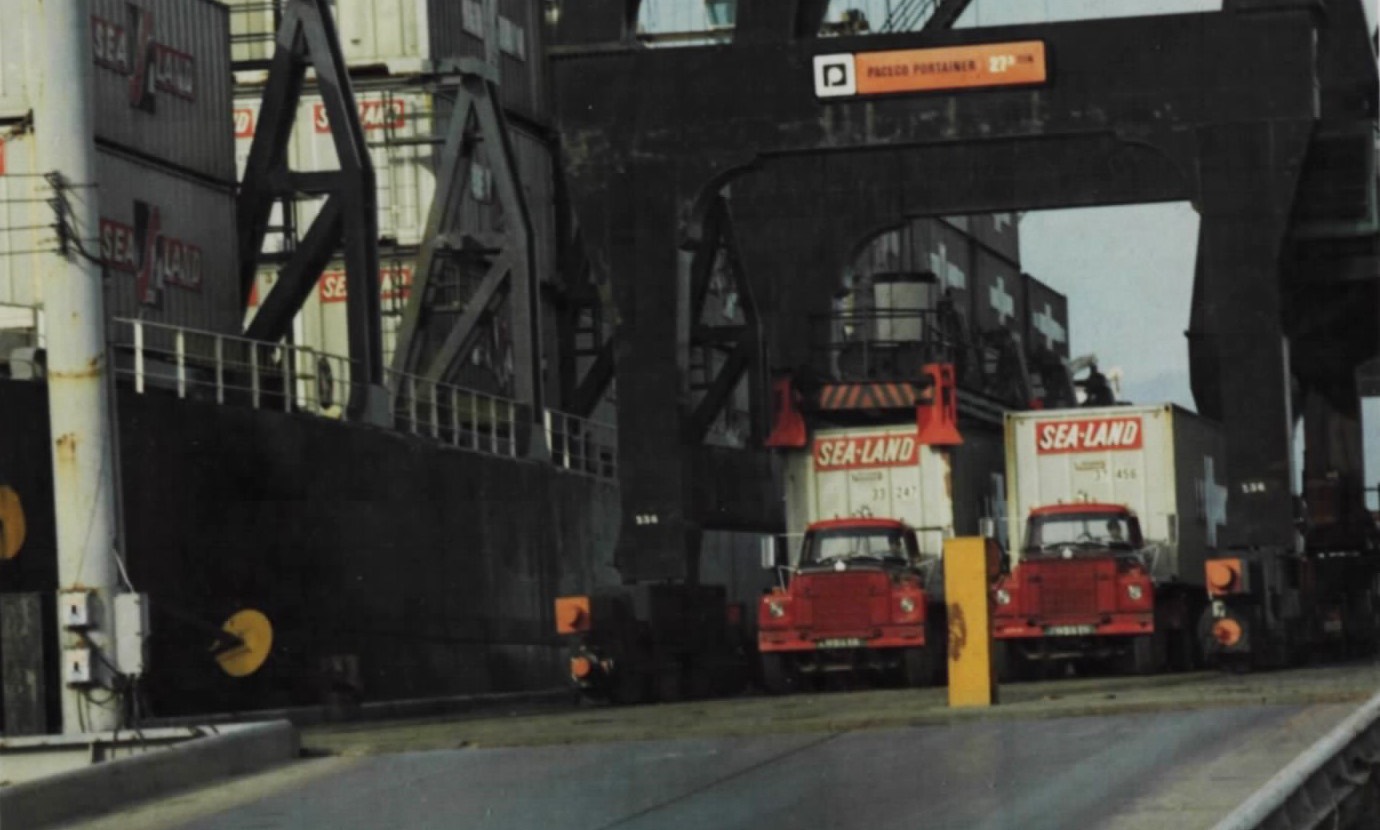
Full one way, empty the other. Six ships crossing the Pacific loaded with military freight and coming back with nothing in them but air, which is the sort of arithmetic that keeps a haulier awake.
So he went to Japan, whose factories at that moment were turning out more televisions and stereos than they could easily ship, and began running six sailings a month out of Yokohama to the American west coast. The war paid for the westbound leg and Japanese electronics paid for the eastbound one. He had gone there to stop wasting a return trip.
What happened to the docks
New York had been a port for three hundred years, and the work of the port happened in the city: on the Brooklyn piers, on the Manhattan waterfront, in neighbourhoods where a man could get taken on for a shift because his father and his uncle worked the same hatch.
Containers need something that Manhattan does not have, which is flat land. Acres of it, for stacking boxes and swinging cranes and turning lorries. The industry crossed the harbour to Newark and Elizabeth in New Jersey, where the space existed, and by the 1960s containerisation was eliminating thousands of jobs on the New York side. The tonnage through the region held up. The work did not.
The same thing happened in London. The Victorian docks upriver were built for Victorian ships and could not take either the vessels or the land requirement, so the trade went downstream to Tilbury and the enclosed docks began shutting. West India and Millwall stopped handling general cargo in 1980. The Royal Docks closed in 1984.
The box gets blamed for all of this, and that is not quite fair. Containerisation was the largest factor but not the only one. Ships were getting bigger regardless. Industrial relations on both waterfronts were genuinely poor. Newer private ports were competing hard. Sorting out how much of the collapse to assign to each of those is a live argument among historians and it has not been settled.
What is not in dispute is who paid. The men who lost those jobs were not the men who decided to containerise, and the gain from the change, which was enormous, went almost entirely to people who had never lifted a hook.
Where the factories went
Cheap shipping does something strange to a map.
When it costs a lot to move a finished object, you build the object near the people who will buy it. When it costs almost nothing, the cost of moving it stops being a factor in the decision at all, and you build it wherever the labour and the land and the rules suit you best. That is what made the present arrangement of world manufacturing possible in the first place.
The numbers give the shape of it. Container traffic is counted in twenty-foot units, so a forty-foot box counts as two. World throughput was 36 million of those units in 1980. It was 545 million by 2010, and 849 million in 2021. Singapore on its own handled 41.12 million in 2024, more than the entire planet managed in 1980.
India came late to this and is now moving quickly. Jawaharlal Nehru Port was commissioned at Nhava Sheva on 26 May 1989, and it now handles around half of all the containerised cargo passing through India's major ports. In the 2024 calendar year it moved 7.05 million units, the first time it had crossed seven million.
The gap that is left is transhipment, the business of collecting boxes from smaller ports and consolidating them onto the big ocean-going ships. India has never had much of it. Colombo alone still handles about seventy per cent of the transhipment cargo bound for India. Vizhinjam on the Kerala coast was built to take that work back, and on 9 June 2025 it berthed the MSC Irina, rated at 24,346 twenty-foot units.
Twenty-four thousand three hundred and forty-six. Port Houston puts the Ideal X, on the day that started all of it, at just over a hundred.
The photograph at the top of this piece was taken at Cam Ranh Bay on 16 December 1968, ten months after the ISO Council signed off the standard. A steel box is hanging in the air on four wires with a crane driver watching it from a cab, and it is the same box, to the inch, that came past your house on the back of a lorry this week.
Sources
- Port Houston, "Ideal X" (the 26 April 1956 departure from Port Newark, the 58 containers of 35 feet, the converted Second World War tanker, the five day passage, the loading time of under eight hours, and the load being equivalent to just over 100 twenty-foot units).
- The Geography of Transport Systems, Hofstra University, "First Containership, Ideal-X, 1956" (the 5.83 dollars a ton against under 16 cents a ton, the 15,000 tons of petroleum carried below deck, and the ship being scrapped in 1964).
- Flexport, "An Interview With Marc Levinson, Author of 'The Box'" (both Levinson quotations, the judgement that the 1937 story is invented, the timing objection to it, and McLean allowing free use of his patents).
- International Organization for Standardization, "ISO/R 668:1968, Dimensions and Ratings of Freight Containers" (Technical Committee 104 and its American secretariat, work beginning in 1961, the 1964 draft, the May 1965 circulation, the list of countries approving and the five opposing, acceptance in February 1968, and the quoted definition of a freight container).
- The Maritime Executive, "The Story of Malcom McLean" (the 1937 anecdote as it is usually told, the tanker's conversion, and the Gateway City sailing on 4 October 1957 as the first container-only vessel).
- Forbes, "The Box That Changed Asia and the World" (the 1967 Cam Ranh Bay contract, Sea-Land paying for the pier, cranes and terminals itself, 450 million dollars of defence revenue between 1967 and 1973, 30 per cent of sales in 1971, 99 per cent capacity in 1968, the empty eastbound legs and the six sailings a month from Yokohama).
- American Business History Center, "Malcolm McLean: Unsung Innovator Who Changed the World" (McLean Trucking being eighth largest by revenue and third by after-tax profit in 1954, and the 1969 sale to R J Reynolds for 500 million dollars).
- New York City Department of Records and Information Services, "New York's Working Waterfront" (containerisation eliminating thousands of New York dock jobs by the 1960s, and the cargo industry moving to Port Newark for the space).
- Canal and River Trust, "History of London Docklands" (containerisation driving shipping out of central London, the West India and Millwall docks ending general cargo work in 1980, and the Royal Docks closing in 1984).
- Port Economics, Management and Policy, "World Container Throughput, 1980-2024" (36 million TEU in 1980, 545 million in 2010 and 849 million in 2021, compiled from Drewry Shipping Consultants and UNCTAD).
- Maritime and Port Authority of Singapore, "Strong Growth Momentum for Maritime Singapore" (41.12 million TEU in 2024, up 5.4 per cent, in the release of 15 January 2025).
- WorldCargo News, "JNPA hits record 7.05m TEU in 2024" (Nhava Sheva crossing seven million boxes for the first time in the 2024 calendar year).
- Jawaharlal Nehru Port Authority, "About Us" (commissioning on 26 May 1989, and the port accounting for around 50 per cent of containerised cargo across India's major ports).
- Observer Research Foundation, "Vizhinjam Port: Competition or Complementary to Colombo?" (Colombo handling about 70 per cent of India-bound transhipment cargo).
- The Mediterranean Telegraph, "MSC shatters records with delivery of 24,346 TEU MSC Irina" (the rated capacity of 24,346 twenty-foot units).
- Adani Ports, "World's Largest Container Ship MSC IRINA Makes Historic Debut at Vizhinjam International Seaport" (the MSC Irina berthing at Vizhinjam on 9 June 2025).