Global Affairs · 2026-07-17 · 12 MIN
Why It Was Europe: How a Small, Divided Corner of the World Ended Up Ruling Most of It
For most of history Europe sat on the modest edge of a world whose wealth and learning lay elsewhere. Then a handful of small Atlantic kingdoms went out across the oceans and came to rule much of the planet. Not because their people were cleverer or braver, but because a particular mix, geography, disease, a genuine edge in ships and finance, and relentless rivalry at home, happened to come together in one place at one time.
Stand in the year 1400 and look at the world, and you would not pick Europe to win it.
The richest, most crowded, most inventive places on Earth were elsewhere: huge cities, paper money, gunpowder, printed books, ocean-going fleets and centuries of science and trade, most of it far to the east and south of Europe. Europe, next to any of that, was a cold and fragmented region on the far western edge of Asia, less wealthy than the great civilisations it traded with and often learning from them, buying its luxuries from afar with silver it could barely spare.
And yet, within a few centuries, a handful of small kingdoms off that western edge, Portugal, Spain, the Dutch Republic, England, France, went out across the oceans and seized, settled or dominated a startling share of the planet. By 1900 a few European capitals ruled most of the map.
The question that leaves is the oldest and most loaded one in world history. Why them? The tempting answer, the one Europeans told themselves for centuries, was that they were simply better: braver, cleverer, chosen. That answer is not just ugly. It is wrong, and the plainest evidence against it is the fact that for most of recorded history Europe was the student, drawing on older and richer civilisations rather than leading them. Something changed, and it was not the European mind.
What changed was a stack of advantages, most of them accidents of geography, biology and timing, that happened to pile up in one place at one moment. Pull any single one of them out and the story runs differently. Here is the stack.
The luck of the land
Start with the deepest layer, the one that is not really about any people at all, but about the ground under their feet.
Thousands of years before any of this, the shape of the continents dealt each part of the world a different hand. Eurasia runs east to west, one long band of roughly similar climate, so a crop or an animal tamed in one place could spread sideways for thousands of miles without meeting a new season. That made for early farming across the whole landmass, and farming made for dense populations, cities, writing, metalwork and states. The Americas and Africa run north to south, so useful plants had to be dragged across deserts and shifting daylight, and after the last ice age those continents had far fewer large animals left that could be domesticated. Great and sophisticated civilisations grew up everywhere. But the raw materials of the kind of power that would later matter at sea, steel, gunpowder, draught animals, crowd diseases, were spread unevenly by nothing more principled than climate and luck.
This is the argument the geographer Jared Diamond made famous, and the key thing about it is what it is not. It is not a claim that some peoples were cleverer than others. It is a claim that the land was kinder to some than to others, and that the difference had nothing to do with the worth of anyone living on it. Hold on to that, because the next layer is where the luck turns cruel.
The germs did the conquering
Here is the part the heroic paintings leave out. What emptied the Americas was not the sword. It was the invisible cargo the newcomers carried in their blood.
Having lived for thousands of years packed in with cattle, pigs and poultry, the peoples of Eurasia had marinated in a whole zoo of animal-borne diseases, smallpox, measles, influenza, and had paid for it over the centuries with untold deaths and, in the survivors, a hardened resistance. The peoples of the Americas had no such history behind them, and so no such immunity. When the two worlds met after 1492, the diseases tore through the Americas like fire through dry grass. Smallpox and the rest killed, by many estimates, somewhere between half and nine in ten of the population within a century, often running ahead of the newcomers themselves, so that arrivals found country already emptied of the people who had lived there.
No army, however determined, conquers a land of tens of millions with a few hundred men. Disease is what did it. The invaders often walked into places where most of the defenders were already dead or dying. It was one of the largest catastrophes in human history, and it was nobody's plan; no one in 1500 understood germs. Europeans gained the Americas because of an accident of their own long past of living packed together with livestock, and it is worth saying plainly that ending up on the lucky side of a plague is not a virtue, and losing to one is not a fault.
The same brute fact runs the other way, and that is the real tell. In the tropics the diseases often favoured the locals. Malaria and yellow fever killed European newcomers so fast that for almost four hundred years they clung to a few forts on the coast and could not push inland, not for want of guns but for want of immunity. Vast regions were not colonised in the age of the first voyages at all. They were reached only much later, once new medicine held the fevers off and new weapons tilted the odds. Same outsiders, same ambitions; what changed was the science. That is about as clean a proof as history offers that this story turns on circumstance, not on the worth of one people or another.
A continent that could not stop
So the wider world was, tragically, open. But plenty of societies had ships and wealth and gunpowder. Why was it these particular small kingdoms that kept pouring out across the oceans, decade after decade, when so much of that expansion was expensive, dangerous and, for long stretches, unprofitable?
A large part of the answer is that Europe could not stop itself, because there was no one in charge of it to call a halt.
Europe was a jumble of hundreds of kingdoms, republics, princedoms and city-states, packed onto a continent so cut up by mountains, rivers and peninsulas that no single power could ever swallow the rest. That had a strange consequence. A land under one ruler can decide, all at once, that a grand and costly adventure is not worth it, and simply end it. A continent of rivals can never make that decision, because there is always another court, another crown, another merchant willing to take the gamble the last one refused.
Columbus is the clearest example. He hawked his plan around the courts of Europe for years and was turned down more than once before Spain, freshly finished with a long war at home, finally gambled on him. In a land of competitors, even a wild idea only has to find one backer, and there was always one more to ask.
The economic historian Philip Hoffman has pushed this point further. Europe's states were not only many; they were locked in almost constant war with rivals roughly their own size. From 1500 to 1800 the great powers of the continent were at war more years than they were at peace. That relentless, evenly matched competition worked like a hard school, one that kept forcing improvement in exactly the things that would later prove decisive far from home: cannon, handheld guns, fortifications and, above all, fighting ships. Europe grew unusually advanced in these fields not because its people were fiercer, but because its fragmentation kept its states competing, and centuries of that competition sharpened real skill. They came out of it with ships and gunnery good enough to let a small crew project power along a distant coast.
The gun on the ship, and the money behind it
That skill took a physical shape: a wooden ship that could cross an ocean and fire a wall of iron.
Europeans did not invent most of the pieces. The compass came from far to the east. The lateen sail and much of the underlying mathematics reached them through the Islamic world. What Europeans did was bolt the pieces into something new, a sturdy full-rigged ship that could beat against the wind and take the open Atlantic, and then they lined its sides with heavy cannon. Such a ship became a floating fortress that could sink a rival, batter a harbour and carry that threat anywhere the sea reached.
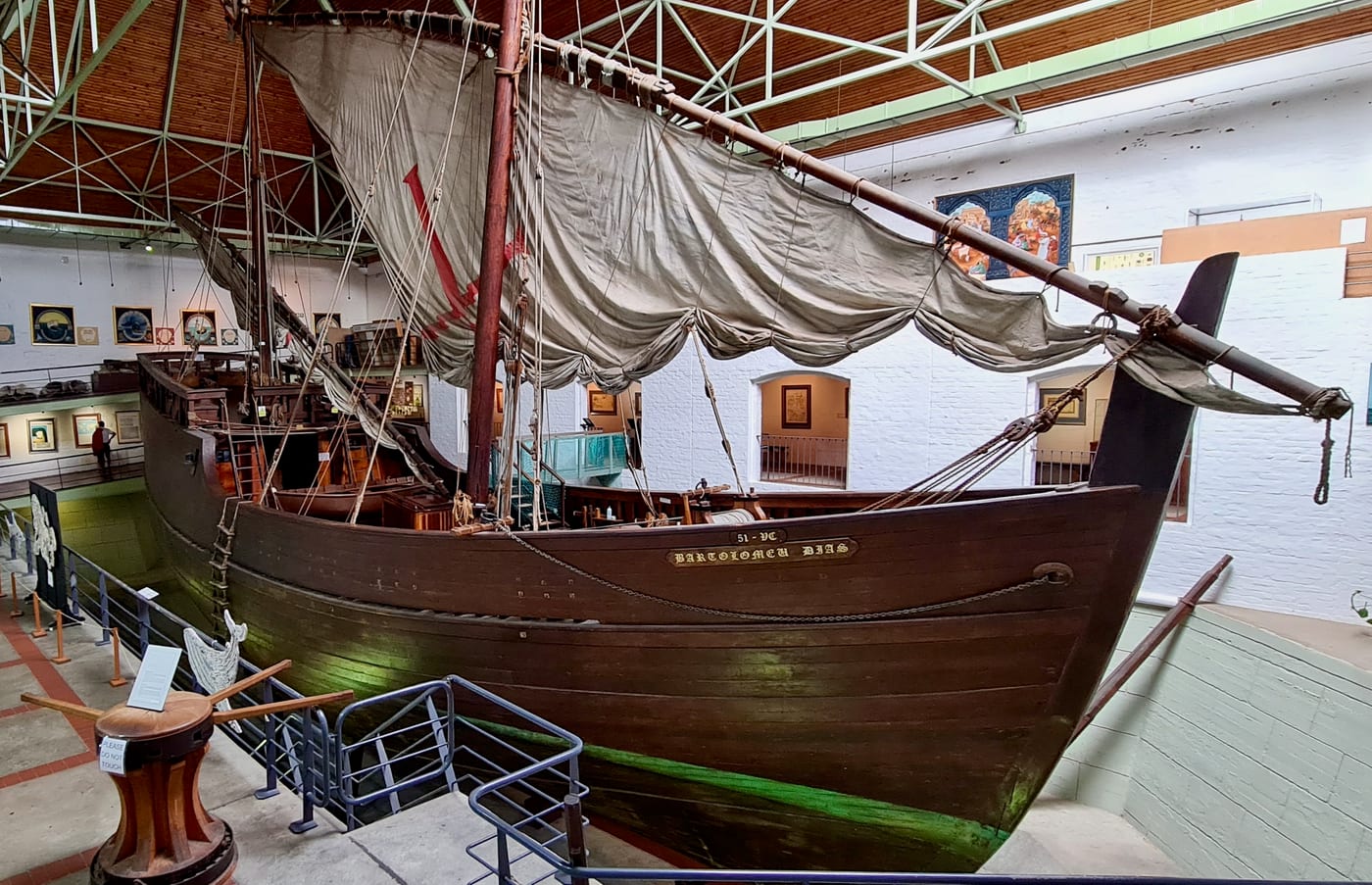
A full-size replica of the small, nimble caravel of the sort used on the early ocean voyages, at the Bartolomeu Dias Museum in Mossel Bay, South Africa. Ships like this, cheap to build and able to sail against the wind, opened the coasts. Photo by Bernard Dupont, CC BY-SA 2.0, via Wikimedia Commons.
Then there was the money, which is the quiet hero of the whole story. Long ocean voyages were ruinously expensive and likely to end with everyone dead. No single merchant could carry that risk. So Europeans, the Dutch and the English first, built a machine for it: the joint-stock company. Hundreds of strangers could each buy a share, spread the danger and split the profit, and if a ship went down they lost only their stake. The Dutch East India Company, founded in 1602, was the first of them, and it grew into something the world had not seen before, a private business with its own fleets, forts and armies, funded by a stock market and backed by the state. Long-distance venture, in effect, became something you could invest in. That financial trick, dull next to cannon and caravels, is a large part of why small countries with few people could suddenly throw their weight across whole oceans.
The hunger, and the head start
There is still the question of why Europeans wanted to go at all, badly enough to sail off the edge of their own maps. The answer is that they were on the outside looking in, and they knew it.
All the finest goods came from far away. Pepper, cinnamon, cloves, silk, porcelain, the luxuries European elites craved, were grown and made in distant lands and reached Europe only after passing down a long chain of merchants and rulers, each adding a markup, so that by the time they arrived the price was enormous and the supply a trickle. Europe was the far end of the pipe. That is a powerful reason to go looking for a back door. The wealthy heartlands that produced these goods had everything they needed and little cause to go hunting; the hungry edge had every reason to climb into a boat and sail around. The people with the strongest push to cross the oceans were exactly the ones stuck on the outside of the world's prosperity.
And once they broke through, success fed on success. Silver dug out of the Americas gave Europe the one thing that could finally buy its way into the rich markets it had always envied, because silver, as it happened, was what those markets wanted. New crops carried home in the ships, the potato and maize above all, fed a European population that then grew and pressed outward harder. Each colony helped pay for the next fleet. Each stretch of coast mapped made the following voyage a little safer. A head start of a few decades in the 1490s compounded, over centuries, into a lead that looked, from the outside, like destiny.
Circumstance and skill, not superiority
Put the layers back together and the picture is clear, and it flatters no one's pride.
The wider world was laid open by an accident of biology, a load of diseases some populations carried and others had never met. The tools of conquest were spread unevenly across the world by an accident of geography, the shape of the continents and the animals and plants that happened to live on them. And the particular people who picked up those tools and sailed out to use them did so not because of anything in their blood, but because their homeland was restless and competitive, hungry for what the wider world offered, standing on the Atlantic at the exact moment the oceans turned into a road, with hard-won skill at sea and a new way of pooling money to pay for the trip. Change the disease map, or unite that fragmented continent under one cautious ruler, or shift the trade routes a little, and the last five hundred years look different.
None of this is destiny, and it is worth being honest that none of it is an excuse either. Explaining why the conquests happened is not the same as saying they were right; the empires that grew out of all this were built on invasion, coercion and plunder, and much of the world is still living inside the shape they left. Scholars argue about the weightings, too. Some put more on geography, some on ideas, some on laws and institutions, and some think the whole European lead was a late, lucky accident rather than anything deep. The honest answer is that no single cause carries the story. It was a stack, and the stack happened to line up in one corner of the map.
The comforting myths get it wrong from both directions. Europeans did not take the world because they were a superior people, and the peoples whose lands were taken did not lose them because they were lesser ones. A fragmented, striving region caught a long run of geographic and biological luck, turned centuries of rivalry into real skill at sea, built the finance to pay for the voyages, and happened to be standing at the door of the oceans when it swung open. That is a story of circumstance and hard-won ability together, not of one people being worth more than another. Pretending otherwise, in either direction, is how the old myths survive.
Sources
- Encyclopaedia Britannica, "European exploration" (on the Age of Discovery, its motives and its sequence).
- Encyclopaedia Britannica, "Treaty of Tordesillas" (on the 1494 line dividing the newly mapped world).
- Encyclopaedia Britannica, "Columbian Exchange" (on the movement of diseases, crops and people after 1492).
- Encyclopaedia Britannica, "Dutch East India Company" (on the first joint-stock company to wield its own fleets and forts).
- Jared Diamond, "Guns, Germs, and Steel" (on geography, domestication and disease as the deep, impersonal causes).
- Philip T. Hoffman, "Why Did Europe Conquer the World?" (Princeton University Press, on constant war as the engine of European military advantage).
- Kenneth Pomeranz, "The Great Divergence" (Princeton University Press, on how recently and contingently Europe pulled ahead).
- Wikipedia, "Great Divergence" (on the long debate over why Western Europe overtook older economic centres).